Nom i cognoms / Name and surname
Quique Bassat, Bàrbara Baro, David Torres, Inacio Mandomando, Anthony Batte, Nega Assefa, Lola Madrid, Maxime Agnandji, Chris Buck, Jahit Sacarlal
Afiliació / Affiliation
ISGlobal – Barcelona Institute for Global Health; Universitat Politècnica de Catalunya (UPC)
Programa de finançament europeu en que s’enmarca aquest projecte? / European funding programme in which this project is being carried out?
Other (EU support, FP7, H2020, etc.)
Títol del projecte / Project title
ACROBAT-Newborns: Appraising the Critical Role of Prognostic Biomarkers in the Assessment and Triage of Sick African Newborns
Número del projecte / Project number
101158797
Breu explicació del projecte / Brief explanation of your project
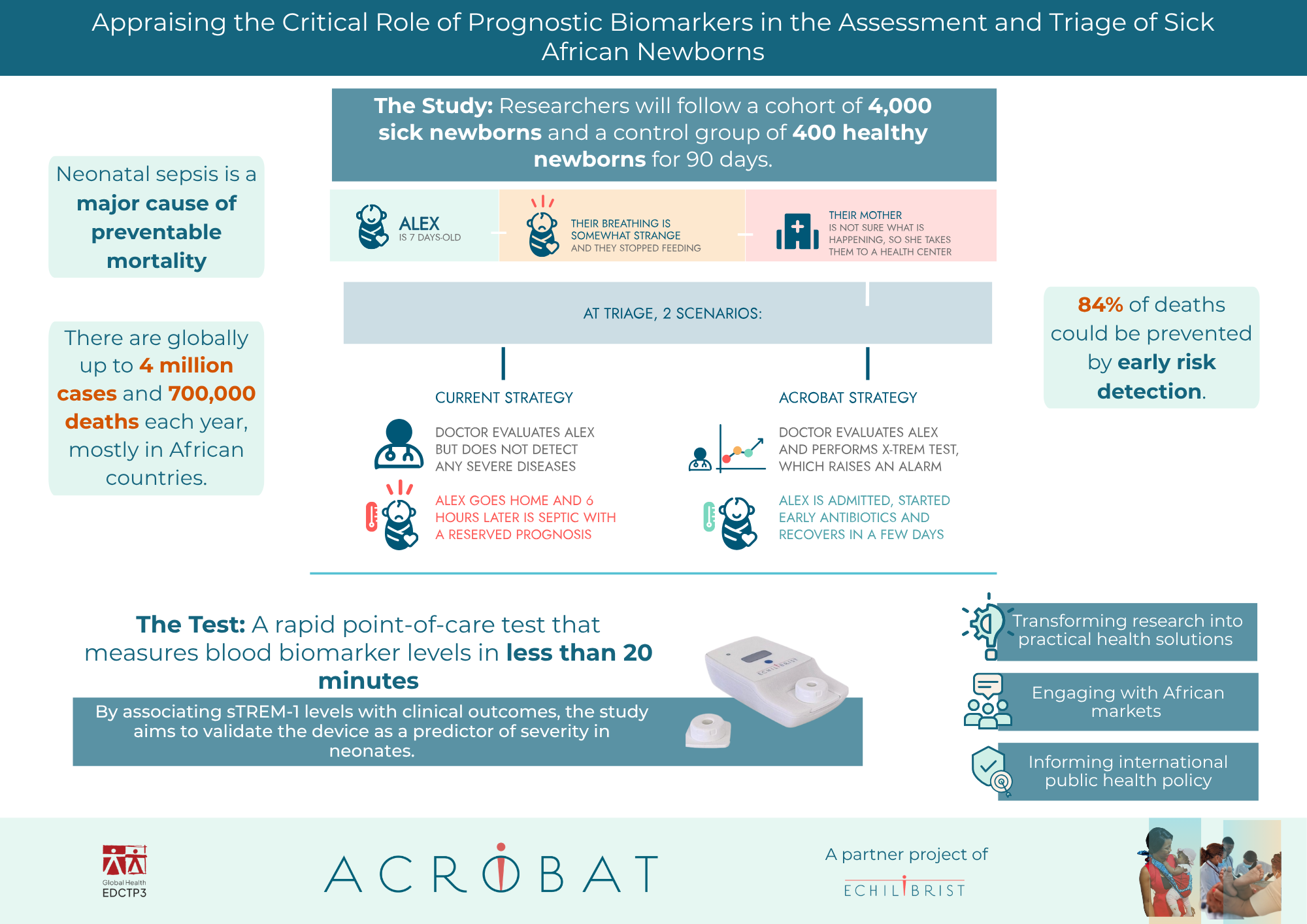
ACROBAT-newborns is a consortium led by the Barcelona Institute for Global Health (ISGlobal) and funded by the European Union’s EDCTP3 programme. It aims to evaluate the performance of xTREM; a rapid point-of-care prognostic test which measures the levels of the biomarker sTREM-1 to predict severe illness (regardless of its cause) in sick newborns. The study will be conducted in four hospitals in Ethiopia, Gabon, Mozambique, and Uganda.
Newborns are at the greatest risk of dying from severe infections, such as sepsis. According to the World Health Organization (WHO), there are between 1.3 and 2.9 million cases of these infections each year, resulting in 400,000 to 700,000 annual deaths worldwide. This burden is disproportionately higher in low-and middle-income countries. Around 84% of neonatal deaths from infection could be prevented with early detection. However, this is challenging in newborns due to the nonspecific nature of symptoms and the rapid progression of the disease. The goal of ACROBAT-Newborns is to overcome the triage barrier to effectively identify those babies at risk of dying.
The project is structured through three main work pillars:
1) A clinical cohort study recruiting up to 4,000 sick and 400 healthy newborns across four hospitals in low-income countries, aiming not only to evaluate the performance of xTREM but also to advance the discovery of additional prognostic biomarkers.
2) An innovation and go-to-market strategy to accelerate the valorisation of the device, the
industrialisation of its prototype, and its commercialisation to ensure it reaches markets in resource-limited settings.
3) An evaluation of the overall impact of xTREM from the perspectives of health economics, health impact assessment, and socio-behavioural sciences, including usability, acceptability, and feasibility studies.
This new risk-stratification tool could be a paradigm change that transforms neonatal triage, helping to predict severe illness, prevent mortality, and reduce long-term sequelae.
Enllaç a la pàgina web del projecte / Link to your project website